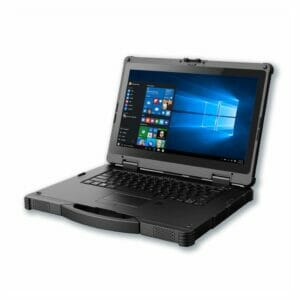
Important notice: Minno is not ML Rugged. [
In high-frequency, fast-moving environments, every operation eventually hits that moment. A technician drops a device on a concrete floor. A forklift driver’s tablet gets splashed during a warehouse wash-down. A field crew is working in 105°F heat, and their screen suddenly goes blank.
If your team relies on consumer tablets, these aren’t edge cases; they’re part of the daily reality.
And the real cost isn’t the device. It’s the moment you lose.
One failed screen can stall a task, delay a decision, or break the flow of an entire workflow. In fast-moving environments, even a few minutes of downtime can ripple outward, slowing teams, impacting output, and in some cases, creating safety risks. When operations depend on real-time data, there’s no buffer for failure.
Rugged tablets exist because the real world doesn’t pause for fragile hardware. They’re designed to remove that point of failure, giving teams the reliability to keep moving, no matter the conditions. That added layer of resilience isn’t just protection, it’s an operational advantage.
In this guide, we’ll break down everything you need to know: ‘what is a rugged tablet?’, ‘what makes them different? ‘, ‘where they’re used?,’ and ‘why the right device pays for itself many times over?’
What Is a Rugged Tablet?
So, what is a rugged tablet in practical terms?
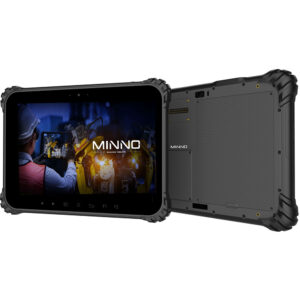
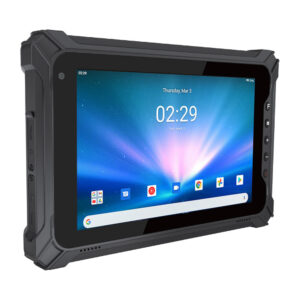
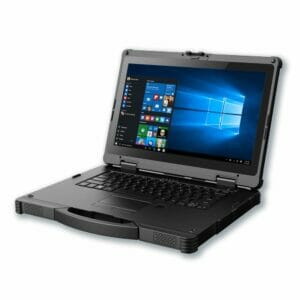
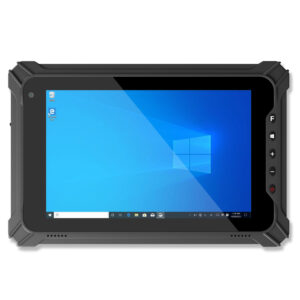
A rugged tablet is a purpose-built mobile computing device engineered to operate reliably in harsh and unpredictable environments. Unlike standard tablets, these devices are designed to withstand physical stress, environmental exposure, and continuous use in demanding conditions.
This isn’t just about making a device tougher. It’s about designing it for real-world work.
Rugged tablets typically fall into three categories:
- Consumer tablets: Built for controlled environments like offices and homes
- Semi-rugged tablets: Offer some durability, suitable for light industrial use
- Fully rugged tablets: Engineered for extreme conditions, including heavy impact, dust, water, and temperature fluctuations
Fully rugged devices are tested to standards such as MIL-STD-810H and have high ingress protection ratings, ensuring they perform consistently when other devices fail.
Once you understand ’what is a rugged tablet,’ the difference becomes clear: these devices aren’t built to survive accidents; they’re built for environments where stress is constant.
Why Rugged Tablets Are Essential for Industry
In many industries, device failure isn’t just inconvenient; it’s expensive. A cracked screen or dead battery can deay operations, disrupt workflows, and in some cases, create safety risks. When teams depend on real-time data to make decisions, reliability becomes non-negotiable.
Rugged tablets solve this by acting as dependable, always-on tools in environments where traditional devices fall short.
They enable:
- Uninterrupted workflows in unpredictable conditions
- Reduced downtime caused by device failure
- Real-time access to critical systems and data
- Lower long-term costs through fewer repairs and replacements
In this context, rugged tablets aren’t just hardware. They’re part of the operational backbone that keeps teams moving.
Fundamental Features of Rugged Tablets
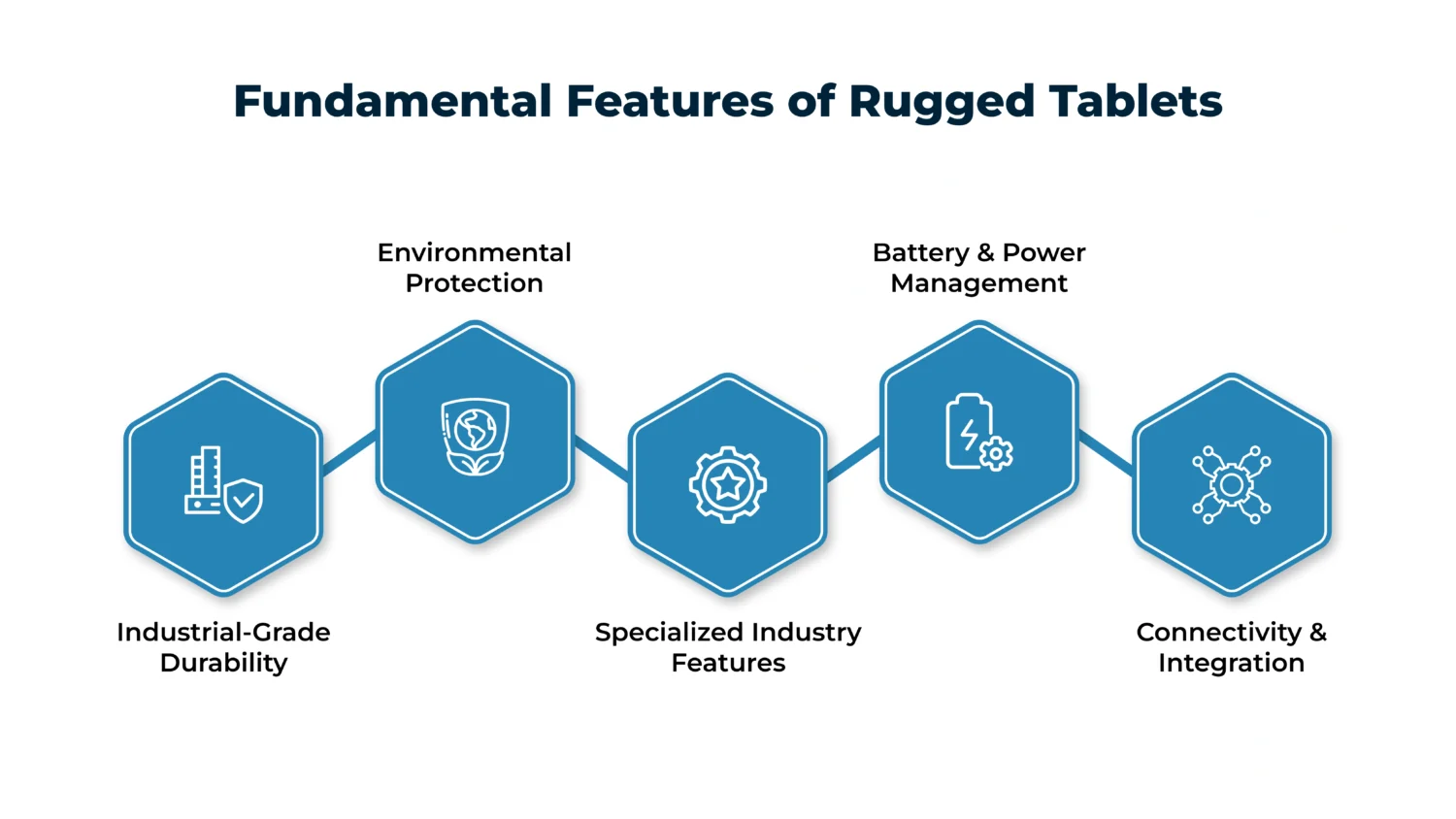
To fully comprehend ‘what is a rugged tablet’ and the value it delivers in real-world environments, it helps to look closely at how these devices are built. Their design is not just about durability for its own sake.
Every feature is engineered to solve a specific operational challenge, from harsh conditions to constant field use. Here are a few features that set rugged tablets apart from standard tablets.
Industrial-Grade Durability
Rugged tablets are engineered to withstand drops, shocks, and constant vibration that would quickly damage standard devices. Reinforced frames, impact-resistant glass, and sealed internal components protect against physical stress.
Most fully rugged devices are tested to MIL-STD-810H, which covers conditions such as repeated drops, extreme temperatures, humidity, and altitude. The key is not just certification, but how extensively those tests are applied.
Environmental Protection
Work environments are rarely clean or controlled. Dust, water, and temperature fluctuations are part of daily operations.
Rugged tablets use sealed enclosures and protective engineering to prevent intrusion and maintain performance. Ratings such as IP67 rating indicate full dust protection and resistance to temporary water immersion, making them suitable for outdoor sites, warehouses, and washdown environments.
Specialized Industry Features
Rugged tablets go beyond durability by integrating tools that support specific workflows. These are built into the device, reducing the need for external accessories.
Common features include:
- Glove-compatible touchscreens
- Integrated barcode scanners
- GPS for navigation and asset tracking
- RFID capabilities
- Thermal imaging and high-resolution cameras
- Sunlight-readable displays
This integration simplifies operations while improving accuracy and efficiency.
Battery & Power Management
Field operations don’t stop for charging, and neither should the device. Rugged tablets are designed for full-shift battery life, with many models supporting hot-swappable batteries. This allows users to replace batteries without shutting down, ensuring continuous operation in high-demand or 24/7 environments.
Connectivity & Integration
Reliable connectivity is critical for modern, data-driven workflows.
Rugged tablets support:
- Wi-Fi (including newer standards like Wi-Fi 6/6E)
- 4G/5G cellular connectivity
- Bluetooth and NFC
Just as important is system integration. These devices are built to work seamlessly with enterprise platforms such as ERP, WMS, MDM tools, and IoT systems, ensuring they fit into existing workflows rather than forcing changes.
5 Industries That Rely on Rugged Tablets
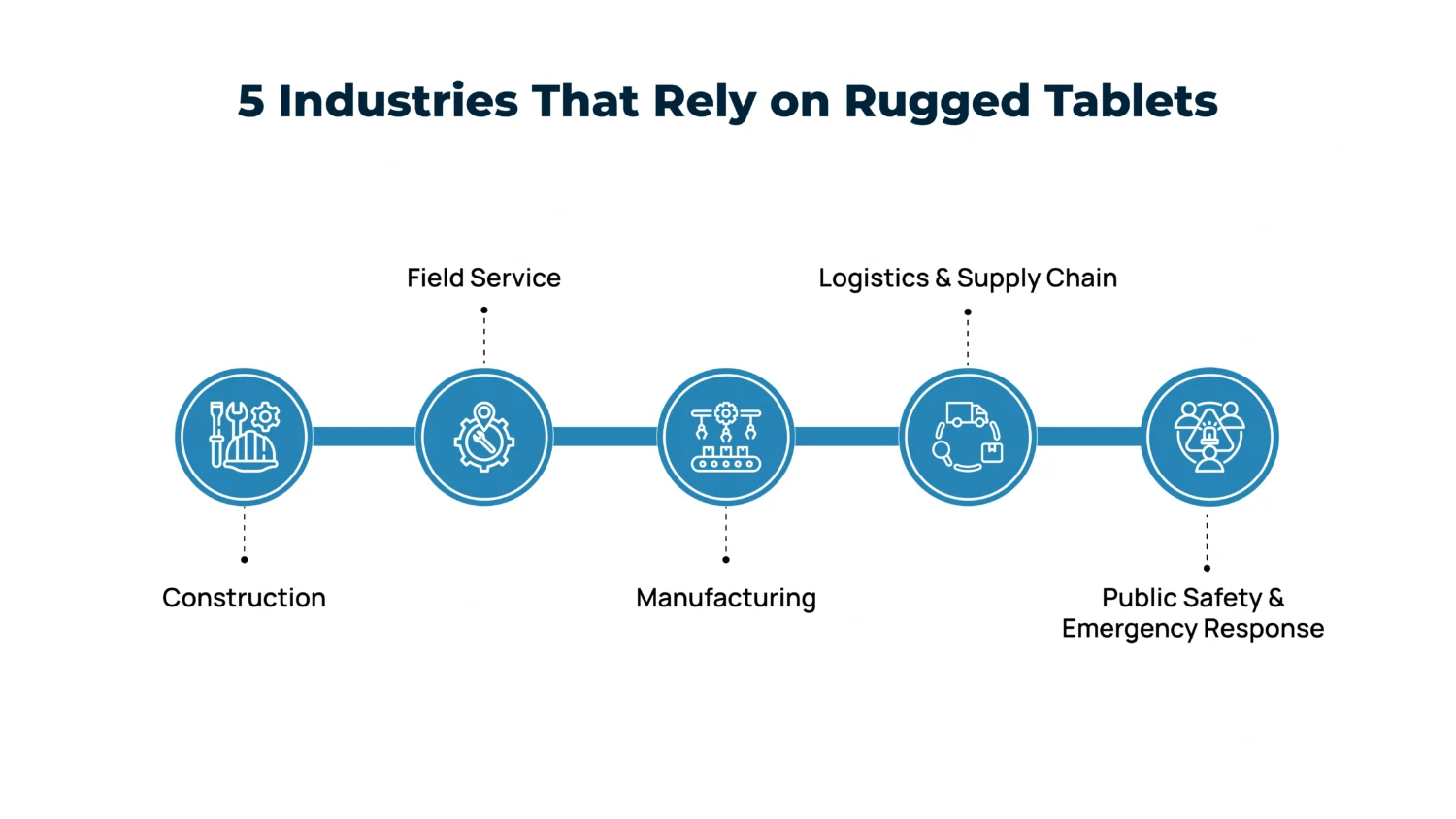
Rugged tablets are used wherever reliability matters more than convenience. While industries differ, the need is the same: tools that work without fail.
- Construction: On construction sites, rugged tablets are used to view blueprints, conduct inspections, and track project progress. They withstand dust, drops, and exposure to the weather.
- Field Service: Technicians rely on rugged tablets for diagnostics, work orders, and reporting. Built-in GPS and scanning tools improve accuracy and reduce manual errors.
- Manufacturing: In manufacturing environments, rugged tablets support production monitoring, quality control, and machine integration. Their durability allows them to operate in areas with vibration, dust, and heat.
- Logistics & Supply Chain: From warehouse floors to delivery routes, rugged tablets enable real-time inventory tracking, barcode scanning, and fleet coordination. They keep data flowing across the entire supply chain.
- Public Safety & Emergency Response: First responders use rugged tablets for communication, incident reporting, and accessing critical data. These devices perform reliably under high pressure and in unpredictable situations.
As we move through 2026, more sectors are becoming dependent on these devices due to their ease of access and reliability. With features like glove-compatible screens and long-lasting battery life, rugged tablets ensure that professionals stay connected and productive in environments where standard devices simply can’t keep up.
Benefits of Rugged Tablets
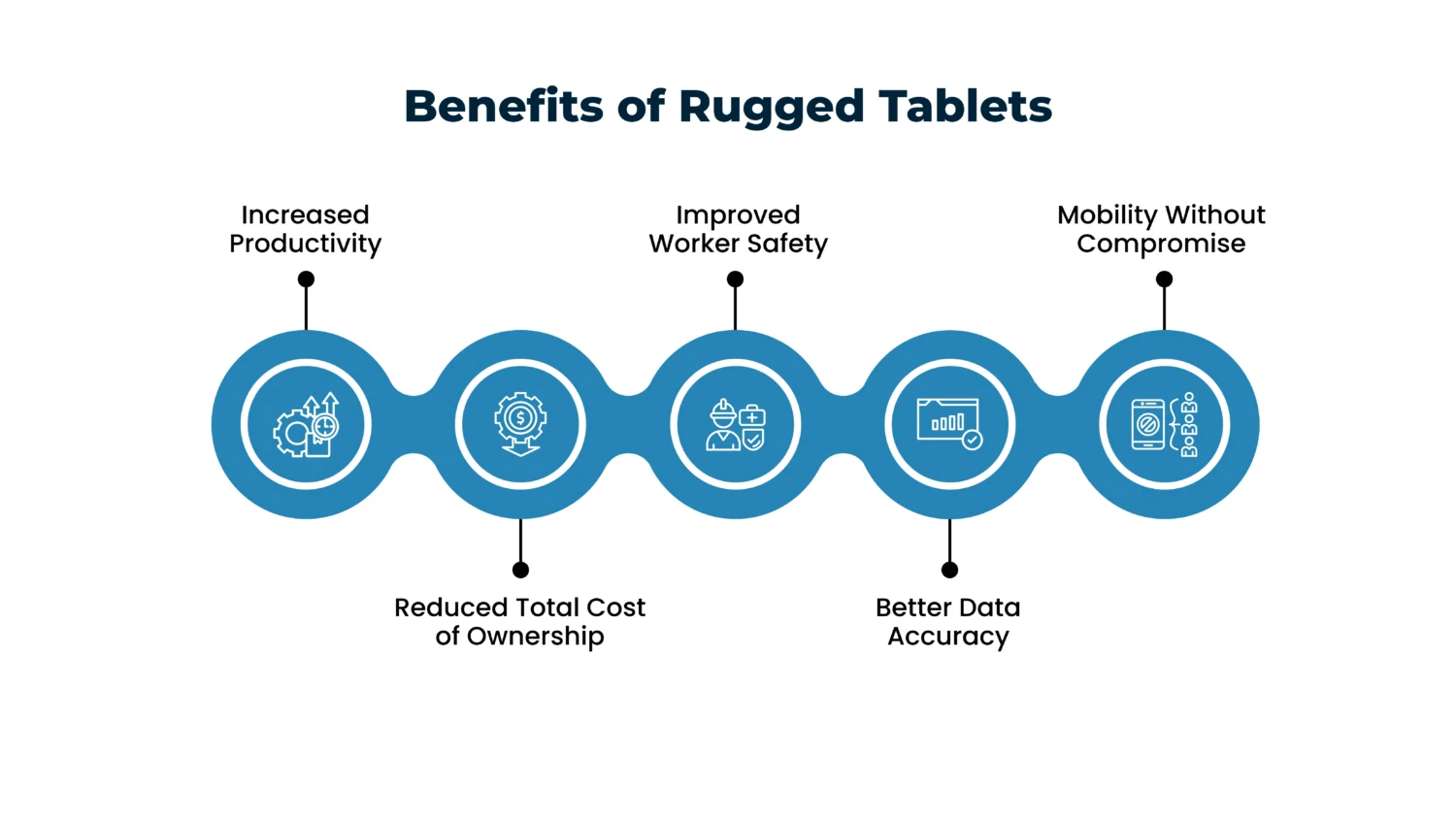
The value of rugged tablets isn’t just in their features; it’s in what those features enable on the ground. When devices are built to handle real-world conditions, the impact shows up in how teams work, how efficiently operations run, and how much downtime gets avoided.
Increased Productivity
When devices stop failing, work stops getting interrupted. Teams spend less time troubleshooting hardware issues and more time completing tasks, whether that’s scanning inventory, accessing work orders, or updating reports in real time.
The real issue is how quickly small disruptions add up. Even short periods of downtime can slow entire workflows, especially in high-throughput environments where tasks are tightly connected.
According to a Forbes Technology Council article, unplanned downtime costs industrial manufacturers up to $50 billion annually, with some operations losing thousands of dollars per minute when production stops.
Rugged tablets are designed to prevent these interruptions at the source. By reducing device-related failures, they help maintain consistent output, minimize delays, and keep operations running smoothly across every shift.
Reduced Total Cost of Ownership
At first glance, rugged tablets may seem like a larger investment than consumer devices. In practice, the opposite is often true.
Fewer repairs, fewer replacements, and less downtime significantly reduce long-term costs. Add in lower IT overhead and fewer workflow disruptions, and the initial price difference quickly becomes negligible in real operating conditions.
An article by Forbes reports that 98% of organizations say even a single hour of downtime can cost more than $100,000, and industrial manufacturers globally spend an estimated $50 billion annually on unplanned downtime. Any device that reduces failure frequency pays for itself faster than most operations expect.
Improved Worker Safety
In high-risk environments, access to reliable information isn’t optional. Rugged tablets ensure workers stay connected to safety protocols, real-time alerts, and communication systems when conditions are at their most demanding.
According to OSHA incident analysis data, 48% of workplace incidents involved communication as a contributing factor; not equipment failure, not unsafe conditions, but a breakdown in information reaching the right people at the right time.
A device that fails in the field isn’t just a productivity problem; it’s a safety gap. When devices perform consistently in extreme conditions, teams can respond faster, make informed decisions, and reduce the likelihood of errors that lead to incidents.
Better Data Accuracy
Manual data entry is slow and error-prone. Research consistently shows a manual data entry error rate of 1–4% per field, meaning at scale, errors aren’t just possible, they’re mathematically guaranteed. For operations handling thousands of data points per shift, that compounds quickly.
Rugged tablets address this at the source. Built-in barcode scanners, RFID, and cameras capture information directly in the field, eliminating the transcription step where most errors originate. The result is cleaner operational data, less rework, and better decision-making downstream.
Mobility Without Compromise
Mobility shouldn’t come at the cost of performance. Rugged tablets allow teams to move between a warehouse floor, a job site, or a remote field location without losing access to systems, connectivity, or functionality. The experience stays consistent regardless of environment, which matters because inconsistency is where productivity quietly erodes.
In short, rugged tablets don’t just survive tough conditions; they remove friction from daily operations. The result is faster workflows, more reliable data, and teams that can focus on the job instead of the device.
How to Choose the Right Rugged Tablet
When talking about rugged tablets, it’s important to realize that they’re all NOT built for the same job. The right choice comes down to how well the device fits your actual working conditions and operational needs.
Step 1: Assess Your Environment
Start with where and how the device will be used. What temperature range will it operate in? Will it be exposed to dust, water, or washdowns? Is there a risk of drops, and from what height? Will workers use it outdoors in bright sunlight or indoors?
These factors determine the level of durability required, including appropriate ingress-protection ratings and drop-resistance standards.
Step 2: Define Performance Requirements
Next, look at what the device needs to handle. Consider the applications your teams rely on and the processing power required to run them efficiently. Evaluate RAM and storage for your data needs, battery capacity for full-shift use, and connectivity options, such as Wi-Fi 6 or 4G/5G, to ensure reliable access across your network.
Step 3: Balance Usability and Form Factor
A rugged device still needs to be practical to use. Think about screen size, weight, and ergonomics. Larger displays improve visibility, especially for detailed tasks, but portability matters for teams constantly on the move.
Step 4: Identify Required Features
Match the device to your workflows. If your operations depend on barcode scanning, GPS, RFID, or other tools, these features should be built into the device. Integrated capabilities are more reliable and reduce the need for additional equipment.
Step 5: Ensure Connectivity and Integration
Finally, make sure the device fits into your existing ecosystem. It should work seamlessly with your current systems, whether that’s WMS, ERP, or MDM platforms. Compatibility with accessories like vehicle mounts, docks, and peripherals can also significantly impact efficiency in daily operations.
The goal isn’t to choose the most rugged or the most powerful device in isolation. It’s to select one that aligns with how your business actually operates, so it performs reliably where it matters most.
At its core, ‘what is a rugged tablet’ comes down to purpose.
It’s not just a tougher version of a consumer device. It’s a category of technology built specifically for environments where failure has real consequences, downtime, safety risks, and lost productivity
As industries become more connected and data-driven, rugged tablets are no longer optional tools. They’re essential infrastructure.
If you’re ready to find the right device for your environment, explore Minno’s full lineup of Windows, Android, and custom rugged tablets today!
Optimize Your Operations with a Rugged Minno Tablet Solution

Every industry has its own set of challenges, and mobile devices should adapt to those realities, not the other way around. Whether your teams are managing field operations, tracking assets, or conducting on-site inspections, the right rugged tablet setup can make a measurable difference.
Minno rugged tablets are designed for demanding environments and support advanced capabilities, including RFID, barcode scanning, GPS, and real-time connectivity. This enables your teams to capture accurate data, stay connected in the field, and move faster without compromising reliability.
Instead of forcing your workflows into fragile systems, you can deploy a solution built around how your business actually operates, durable, efficient, and ready for the real world

Minno stands for Mobile Innovation and Value
Minno is a privately held manufacturer of full-featured, high-performance rugged tablets (Android and Windows) and custom-designed or branded tablets for industry, education, and governments sold B2B in volume at prices well below retail brands. Minno rugged tablets are designed for high performance, durability, reliability, and versatility. Our tablets will change how your business operates and deliver value to customers by delivering productivity, efficiency, and business agility.