Most manufacturers we talk to assume “AI on the factory floor” means three things: an expensive cloud subscription, a data science team, and a seven-figure integration project.
None of that is true today.
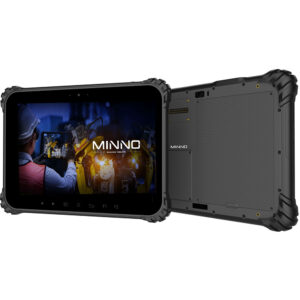
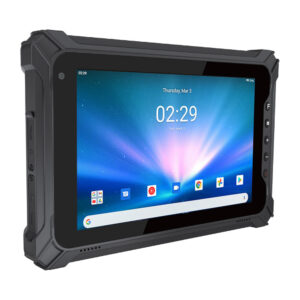
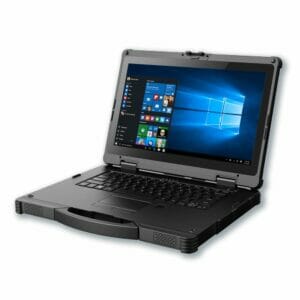
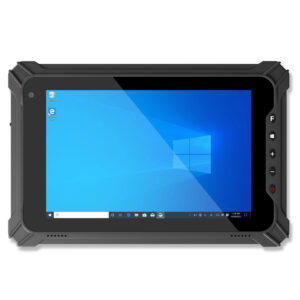
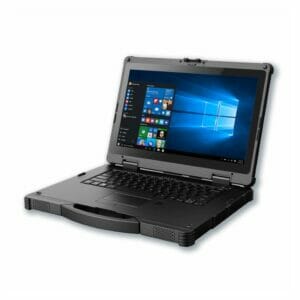
The AI models that are actually driving ROI in manufacturing, such as real-time defect detection, vibration-based predictive maintenance, and vision-guided picking, can now run locally on rugged edge AI computers, fully rugged, AI-capable tablets, and Panel PCs mounted next to the line.
No round-trip to a cloud data center. No huge monthly inference bill. No production stoppage when the Wi-Fi drops.
What is Edge AI in manufacturing?
It is trained artificial intelligence models running directly on hardware in your facility with no need for cloud connectivity. Edge AI is changing the economics of modern manufacturing.
The cloud still has a job: training models and storing historical data. But inference (the moment-to-moment decisions of an AI model (“Is this part good or bad?”) happens on-device. That distinction drives everything else in this article.
What you get from moving inference to the edge:
- Millisecond decisions: A cloud round-trip typically takes 200–500 milliseconds on a good day. Local inference on an NPU-equipped device runs in under 50 milliseconds -fast enough to reject a bad part before the next one arrives.
- Offline operation: Production doesn’t pause when connectivity drops.
- Lower bandwidth costs: A high-resolution inspection camera generates gigabytes per shift. Edge AI analyzes frames locally and transmits only the exceptional images.
- Data stays in the building: Your production IP, quality records, and process telemetry never leave the facility.
What’s Wrong With Cloud AI Work On The Factory Floor?
Cloud-based LLMs transformed office productivity. But factories are a different environment, and the failure points are predictable.
- Latency kills throughput: A conveyor moving hundreds of parts per minute can’t wait half a second per part while a remote server responds. At 300 parts per minute, you have 200 milliseconds per part. Cloud inference doesn’t fit in that window. Local inference does.
- Connectivity is never as good as promised: Manufacturing environments are hostile to wireless, steel walls and structures, machinery, underground operations, and large outdoor yards. If your quality inspection needs the internet to function, you have a problem.
- Bandwidth bills scale with cameras: Every camera you add to a cloud-based vision system adds recurring cost. Edge AI inverts that: the expensive analysis is done once, locally, on your hardware.
- Your process data is your competitive advantage: Most manufacturers, especially with sensitive IP, simply won’t send production imagery offsite. Edge AI makes that a non-issue.
What Can Edge AI Actually Do On A Production Line?
Forget about visions of future tech. Here are four applications generating ROI in plants today.
Machine Vision Quality Inspection
An AI vision model (YOLO is the common family, “You Only Look Once,” a class of models built for real-time object detection) inspects every part as it passes: missing components, bad welds, surface defects, wrong labels, damaged packaging. Inspection happens at line speed, every part, every shift. Defects get caught at the station where they occur, not in final QC after you’ve added value to a bad part.
Predictive Maintenance
Pair vibration sensors and thermal cameras with a local AI model, and maintenance stops being an unwelcome surprise. The system learns normal, healthy motor sounds, vibration, and temperature.
It flags indicators of bearing wear, imbalance, or cavitation days or weeks before failure. That allows management to schedule a repair on your terms, rather than incurring expensive, unanticipated line failures during production.
Digital Work Instructions With Verification
Operators already use rugged tablets for work instructions. Add AI verification, and the tablet doesn’t just show an assembly sequence; it confirms it: right part, right tool, right order. Training time for new operators drops, and so do errors that come with labor turnover and training.
Warehouse & Logistics Automation
Forklift-mounted rugged tablets running local AI handle barcode verification, load confirmation, and vision-assisted picking even in the dead zones between racks. No connectivity, no problem. The work continues, and the WMS syncs automatically when connectivity returns.
What Hardware Do You Need To Run Edge AI?
Here’s where many deployments go sideways, and we’ll concede the obvious point first. Yes, a consumer tablet or a mini PC with a webcam looks like the cheaer path. Until you deploy it. Continuous AI inference is a sustained computational load that generates heat, and consumer devices respond by thermal throttling.
The inspection model that ran beautifully during the demo slows down 40 minutes into the shift (when the device is hot and the ambient temperature has risen), even though production is at full capacity.
Industrial Edge AI hardware is engineered for these demanding workloads, featuring:
- A dedicated Neural Processing Unit (NPU): Purpose-built for AI inference, delivering 12–15 TOPS (trillion operations per second), the standard measure of AI computing performance in rugged tablets.
- Fanless thermal design: Sustains peak performance throughout an entire shift, even in ambient temperatures that consumer devices aren’t designed to handle.
- IP65 to IP68 ingress protection: Sealed against dust, oil mist, washdowns, and, depending on the rating, temporary or prolonged water exposure.
- 500–1000+ nit sunlight-readable displays: Ensure operators can clearly view data and AI insights in bright outdoor environments or industrial facilities.
- Hot-swappable batteries: Keep tablets running through extended shifts without powering down.
- MIL-STD-810H-tested durability: Designed to withstand repeated drops, shock, and vibration in demanding field environments.
When You Need More Computational Horsepower?
Some vision workloads, multi-camera inspection, high-frame-rate lines, and larger models, require more TOPS than any tablet can reasonably deliver. That’s the role of Minno’s Sherpa Series Edge AI computers, which process inference at 50 – 200 TOPS. Sherpa boxes deliver inference horsepower and pair with rugged tablets and Panel PCs to serve as a rugged human-machine interface (HMI).
And because fleets of edge devices need to be managed, Minno Fleet handles enterprise device management and secure updates across the deployment, so your IT people aren’t individually updating fifty tablets every time a model improves or a security patch is released.
One more thing that matters more than any spec: Minno’s service team is US-based. When a device on a production line needs repair or replacement, that happens on a rapid domestic turnaround rather than an expensive, logistically time-consuming six-week trip overseas.
Optimize Your Operations with A Rugged Minno Tablet Solution

Edge AI isn’t about replacing people. It’s about giving a skilled workforce useful information faster. The manufacturers who are getting real ROI from AI are the ones who put the intelligence where the work happens.
Every industry faces unique challenges; your mobile devices should be the solution, not another obstacle. In the field, a high-risk system is a liability. Minno rugged tablets deliver high performance and industrial capabilities, including RFID, barcode scanning, multiple I/O connectivity options, and edge AI to challenging worksites.
If you’re evaluating an edge AI deployment, machine vision, predictive maintenance, or warehouse automation, talk to us. We’ll help you match the hardware to the workload, and we’ll be here when you need us.
Get a rugged tablet custom quote.
Frequently Asked Questions About Edge AI in Manufacturing
- What is the difference between edge AI and cloud AI?
Cloud AI processes data on remote servers over the internet, while edge AI processes data locally on devices within your facility. Cloud AI is well-suited to training models and long-term analytics. Edge AI is built for real-time decisions (“inference”) used in quality inspection and machine monitoring, where latency, connectivity, cost, and data privacy make cloud-based inference impractical.
- Can edge AI work without an internet connection?
Yes. That’s one of its defining advantages. Edge AI models run entirely on local hardware, so inspection, monitoring, and operator guidance continue with or without a network connection, and the cost of running the AI locally approaches zero. Results sync with your MES or WMS when connectivity is restored.
- What is an NPU?
An NPU (Neural Processing Unit) is a processor designed specifically to run AI models efficiently. It performs inference faster and at far lower power than a general-purpose CPU, which is what makes all-shift AI workloads possible on a fanless, battery-powered rugged tablet or rugged AI computer.
- How many TOPS do I need for machine vision?
TOPS (trillions of operations per second) measures AI compute capacity. Single-camera inspection with standard object-detection models typically runs well on 12–15 TOPS, which is met by our current AI-capable rugged tablets. Multi-camera or high-frame-rate applications need more, which is where a dedicated edge AI computer like Minno’s Sherpa Series comes in, capable of running 40–200 TOPS.
- Do I need a data science team to deploy edge AI?
Not anymore. Pre-trained and fine-tunable models cover the common manufacturing use cases (defect detection, OCR, anomaly detection), and deployment is systems integration and hardware choices.
- What tablets support edge AI?
Tablets with a dedicated NPU, sustained (fanless) thermal performance, and industrial-grade protection, IP65 or better, MIL-STD-810H tested. Minno’s NPU-equipped fully rugged tablets and Panel PCs are built specifically for this workload.
When the computational workload is even higher, Minno offers lower-cost rugged tablets that pair with Sherpa AI Computers as a rugged human-machine interface (HMI) and benefit from very high processing speeds.

Minno stands for Mobile Innovation and Value
Minno is a privately held manufacturer of full-featured, high-performance rugged tablets (Android and Windows) and custom-designed or branded tablets for industry, education, and governments sold B2B in volume at prices well below retail brands. Minno rugged tablets are designed for high performance, durability, reliability, and versatility. Our tablets will change how your business operates and deliver value to customers by delivering productivity, efficiency, and business agility.