
Explaining “TOPS”
If you've been shopping for a rugged tablet or an edge AI device, you've definitely seen terms like "12 TOPS" or "15 TOPS" referenced. TOPS stands for Tera Operations Per Second, which means how many trillion (yes, you read it correctly) calculations an AI chip can process every second. A higher TOPS rating means the device can process AI faster. But high TOPS devices are very expensive and rarely needed for typical Edge AI applications.
Note: TOPS is only relevant when you run AI on the device - what we call Edge AI - not when connecting to AI in the cloud, where the computation occurs on remote servers in data centers.

Edge AI is revolutionizing industry
While we are all amazed at the capabilities of Large Language Models (Gemini, ChatGPT, Claude), Edge AI is a quieter revolution happening in industry, enabling solutions like Predictive Maintenance and Smart Visual Inspection, Automated QC, and Co-pilots on rugged tablets that give workers superpowers for functions like maintenance diagnostics and field maintenance.
Some of the benefits of Edge AI vs Large Models for Industry:
- Zero Latency for Real-Time Work: Provides instant results. This is important for tasks like QC inspection on a production line or analyzing sensor data from an oil rig.
- Data Security and Privacy: Your proprietary data stays on your device instead of being uploaded to a third-party LLM on the web.
- Reliability: Many industrial sites have unreliable Wi-Fi or cellular service. Edge AI devices keep working regardless of connectivity and data can be uploaded when connectivity is restored.
- Predictable Costs: You pay for your device and there are no limits or unexpected bills tied to usage.
The Right TOPS Specification To Maximize Your Return On Investment:
Choosing the right TOPS for your device is about matching the hardware to the job.
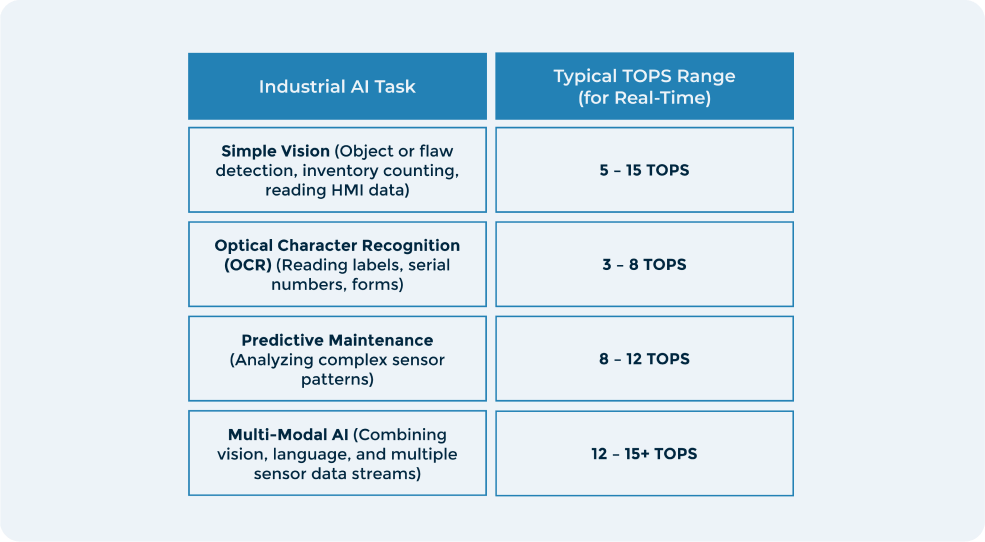
Currently, most industrial edge AI deployments (manufacturing, logistics, warehousing, field service), benefit from devices in the 12–15 TOPS range. They offer enough processing power for sophisticated models while keeping the device affordable, power-efficient, and cool under heavy use. Don’t Get Caught in the more TOPS is better hype.
Some vendors now advertise devices with 30, 40, or even 50+ TOPS. But should you pay for it? Unless you are running multiple models simultaneously, or processing multiple high resolution video streams, or solving a very large complex analytical problem, you are paying a premium for computing power that you will never use. It’s the digital equivalent of buying a massive server rack when a desktop PC could do the job.
TOPS Is One Of Several Considerations For Edge AI
A TOPS number is a theoretical processing speed. Real-world AI performance hinges on a number of other factors as well:
- Optimized AI Models: An efficient AI model can outperform a poorly designed one on a lower-TOPS chip. Programming techniques like quantization make a huge difference in how an AI Agent will run on hardware.
- Chip Architecture (NPU): Some AI chips (like Qualcomm’s QCS6490) are designed for Edge AI workloads and run them more efficiently than a generic CPU.
- Software and Drivers: The quality of the AI inference engine and software optimization can greatly improve performance.
- Thermal Design: If a processor overheats, it will “throttle down,” and that high TOPS processing speed can drop by half. Good hardware thermal design accounts for this to ensure sustained performance.
Recommendation
When you’re ready to invest in industrial Edge AI, focus on these five things:
- Your Use Case: What exactly do you need the AI to do?
- Reliability and Thermal Management: Will it survive the dust, vibration, and temperature extremes of your work environment?
- Total Cost of Ownership: A well-built 12 TOPS device that costs less and lasts 5-6 years in harsh conditions provides a much better ROI than an “over clubbing” with a high TOPS device that you underutilize.
- Examine the broader AI Ecosystem: Is there vendor support, and do you have access to development tools and pre-trained models?
- Build-in Some Headroom: A device in the 12–15 TOPS range provides plenty of horsepower for most Edge AI applications and a buffer for more complex AI Agent capabilities that are sure to arrive in coming years.
Give your team the data they need—right where they work.
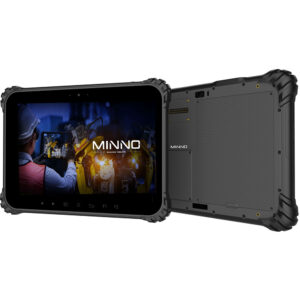
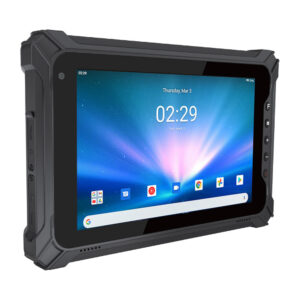
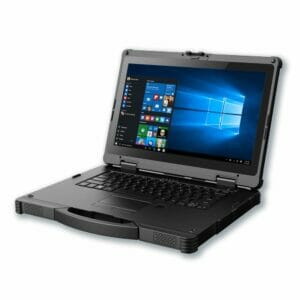
Featured Products
Ready to grow
with Minno?